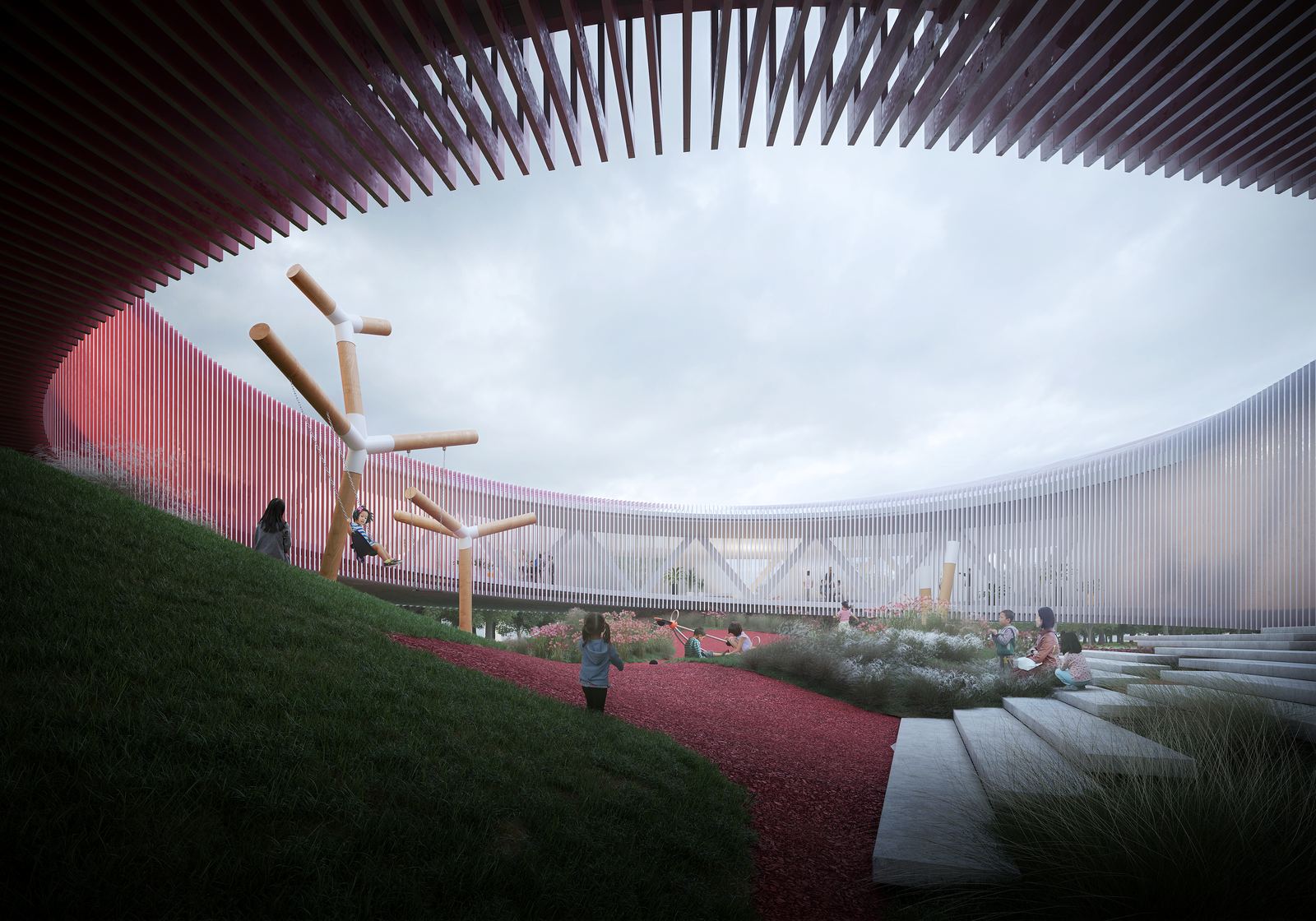
The Attentive School
Six shifts in learning design for the age of AI, social media and demographic change.
Georges Hung
Knowledge is now instant. Attention is not.
For two centuries the school building had one clear job: to bring students, teachers and information into the same room. That job is over. Information reaches every student through a phone, and an AI model can explain, summarise and draft faster than any lecture.
My argument: the value of a place of learning has moved. It is no longer where information is delivered. It is where attention is protected, judgment is formed and belonging is built. I call this the attentive school.
Why now
Four forces are converging on education at once. Each has been discussed on its own. Few school briefs yet respond to all four.
- 95%
- of UK undergraduates now use generative AI. When a machine can produce an answer, education must teach the judgment to question it.
- 65%
- of 15-year-olds across the OECD are distracted by devices in maths lessons. Phone bans have spread from 24% to 58% of education systems since 2023.
- −14%
- Hong Kong primary enrolment in five years—while young populations elsewhere need schools faster than they can be built. One sector, two opposite briefs.
- 44 million
- additional teachers needed worldwide by 2030, as primary attrition nearly doubled. Buildings rarely count in teacher retention. They should.
What the flexible-school consensus gets wrong
Two decades produced a clear consensus: flexible, technology-rich, student-centred, collaborative, sustainable. Each is sound. Together they became a checklist—and a checklist is not a thesis.
- Reconfigurable is not the same as effective. The HEAD study of 3,766 pupils in 153 classrooms found design explained up to 16% of a year’s learning progress—driven by daylight, air, temperature, ownership and the right level of stimulation. Secure the basics first.
- More technology is not more learning. Students given an unrestricted chatbot did better in practice, then scored 17% worse on the exam without it. A version designed as a tutor avoided the loss; a well-designed AI tutor at Harvard more than doubled learning. Design, not access, decides the outcome.
- Open is not the same as collaborative. Without acoustic separation, open learning areas invite noise, not collaboration. Collaboration needs enclosure as much as openness: a table for four with a door that closes, beside a larger room, beside a quiet corner for one.
A movable wall does not compensate for a room that is stuffy, glaring or loud.
Defining the attentive school
A place of learning designed to protect attention, form judgment and build belonging, connected to the life of its city, and able to adapt as its population and pedagogy change. It applies equally to a primary school, a university building or a corporate learning centre.
- AttentionDoes every learner have a calm, daylit, well-ventilated space for focused work, with devices managed by design rather than by rule alone?
- JudgmentAre there spaces to make, test, present, critique and defend work in person, where thinking is visible and cannot be outsourced?
- BelongingDo the in-between spaces—stairs, thresholds, dining, courtyards—give every student somewhere to be known?
- ReachIs the building connected to work, community and city, and open to learners of every age beyond school hours?
- AdaptabilityCan it serve a smaller, larger or different population in twenty years without demolition?
Six shifts
- From device-rich to attention-rich. Daylight without glare, fresh air, stable temperature and acoustic control—the core of both learning and low carbon. Lockers at the entrance and device-free zones marked by material and light make the calmer choice the easier one. Draw device zones on the plan, not only in the handbook.
- From content delivery to judgment formation. When AI can write the essay, assessment moves to what cannot be outsourced: live work, oral defence, making and critique. Fewer rooms sized for listening; more studios, workshops and presentation rooms. The architecture studio, with its desk crits and public reviews, is a model for every discipline.
- From screen networks to real community. School may be the last place young people spend long hours together in person. Belonging is built between classrooms—a generous stair, a dining hall that works as a living room, a shaded courtyard. These are the first spaces cut when budgets tighten. They should be the last.
- From campus to city. Share labs with industry, libraries with neighbours, sports with the community. A building used six hours a day, 190 days a year, is an underused civic asset; opened for adult learning and local enterprise, it becomes neighbourhood infrastructure—and the building itself can teach sustainability.
- From fixed capacity to adaptive estate. A school sized for today may be half empty in fifteen years, or twice as full. Structural grid, floor heights, cores and independent wings decide whether it can become elder care, community hub or housing. Test every new school against two alternative futures at concept stage.
- From building for pupils to building for teachers. The teacher’s workplace is part of the learning environment. Distribute staff space close to teaching, with places to plan together, concentrate and recover. AI can remove hours of administration each week; the building should give that time a place to go.
The framework
The five tests, plus a sixth for the teacher’s workplace, become indicators set in the brief, checked at design review and measured after occupation.
- AttentionShare of teaching spaces meeting daylight, CO₂, temperature and reverberation targets; device-free zones on plan.
- JudgmentFloor area for studio, workshop, lab and presentation, compared with lecture and classroom.
- BelongingIn-between space per student; share of students who say they have a place where they are known.
- ReachHours a week open to the community; active external partnerships.
- AdaptabilityAlternative future uses tested; structural grid and floor-to-floor height.
- TeachersStaff workspace per teacher and its distance from teaching; staff satisfaction with the building.
What this means
Education authorities
- Write attention, judgment and belonging into design standards, alongside area and cost.
- Fund adaptability: require every new school to show two future uses.
- Support phone policies with design guidance, not only rules.
School operators & boards
- Rebalance space from listening to making, presenting and critique.
- Protect in-between and staff spaces when budgets tighten.
- Open the building to the community and lifelong learners.
Developers & master planners
- Place learning at the civic centre of new districts; it anchors community life and long-term value.
- Design shared facilities with separate, secure access from the outset.
Design teams
- Secure daylight, air, temperature and acoustics before flexible features.
- Make the boundary between AI-rich and device-free zones legible.
- Commission post-occupancy evaluation at years one, three and five.
The last shared room
Students no longer come to school because that is where the knowledge is. What remains is what a screen cannot give: the attention of a teacher, the friction of a good argument, the satisfaction of making something by hand, and the experience of being known by name. For many young people, school is now the last shared room—the one place they spend whole days together, in person, away from the feed. The task is no longer to deliver information. It is to build places worth being present in.
The school is no longer where knowledge is kept. It is where attention is given.